CIO View: October 2026
Image

Global markets navigated a challenging environment in October as resilient economic growth and continued AI-driven investment were increasingly offset by heightened geopolitical risks and persistent inflation pressures. Investor attention remained focused on escalating tensions in the Middle East, which pushed oil prices above US$100 per barrel and contributed to greater volatility across financial markets. Meanwhile, major central banks maintained a cautious policy stance amid still-elevated inflation and durable economic activity. Discussions at the 2026 Annual Meetings of the International Monetary Fund (IMF) and World Bank Group in Bangkok reinforced a constructive medium-term outlook for global growth while highlighting geopolitical risks, energy security, and technological transformation as key forces shaping the global economy.
The geopolitical backdrop deteriorated further during October as tensions between the United States and Iran remained elevated following the collapse of ceasefire efforts earlier in the year. Although indirect diplomatic discussions reportedly continued through regional intermediaries, investors remained concerned about the risk of broader military escalation amid ongoing military preparations and continued attacks by Iran-aligned groups throughout the region.
A significant development during the month was the escalation of activity by the Houthis, who launched attacks on international airports in Riyadh and Abha. These incidents underscored the capability of Iran-aligned groups to target strategic infrastructure within Saudi Arabia. At the same time, disruptions and security concerns surrounding the Red Sea and Bab al-Mandeb Strait raised questions about the stability of one of the world's most important energy and shipping corridors.
From a market perspective, these developments led to a repricing of geopolitical risk across asset classes. Concerns over potential disruptions to oil production and transportation supported crude oil prices above US$100 per barrel, reinforcing inflationary pressures and pushing back expectations for monetary easing by major central banks. Safe-haven assets such as U.S. Treasuries benefited during periods of risk aversion, while cyclical sectors and risk-sensitive assets experienced heightened volatility as investors reassessed growth and inflation expectations.
At its October meeting, the Federal Open Market Committee (FOMC) voted to maintain the federal funds rate at 3.75%-4.00%, following the 25-basis-point increase delivered in September. The decision was supported by the Committee's assessment that economic activity continues to expand at a strong pace, supported by resilient domestic spending, robust capital investment, and healthy labor market conditions. At the same time, policymakers acknowledged that inflation remains above the Federal Reserve's 2% target and emphasized the need to gather additional information before determining the appropriate path for monetary policy. Notably, two FOMC members dissented in favor of an immediate 25-basis-point rate increase, highlighting ongoing concerns regarding inflation persistence. During the post-meeting press conference, Federal Reserve Chair Kevin Warsh reiterated that economic growth remains strong and that inflation continues to warrant close attention, while stressing that future policy decisions will remain dependent on incoming economic data rather than a predetermined path. The Federal Reserve also announced a significant change to its meeting structure, reducing the number of regularly scheduled policy meetings from eight to seven in 2027 and six in 2028, with the remaining meetings dedicated to longer-term monetary policy strategy and framework discussions. Additionally, no updated Summary of Economic Projections or dot plot was released at this meeting. The most recent dot plot, published in September, continued to suggest that the median FOMC participant expects only one further 25-basis-point rate increase in December, bringing the target range to 4.00%-4.25%, with no additional tightening thereafter. In our view, and consistent with Chair Warsh's emphasis on allowing more time for incoming data to accumulate, it remains premature to draw firm conclusions regarding the ultimate path of policy rates, particularly as oil prices continue to trend higher amid geopolitical tensions and the U.S. economy remains resilient despite an already restrictive policy environment.
October economic data continued to portray a resilient U.S. economy despite restrictive monetary conditions. Labor market conditions remained healthy, with the unemployment rate rising only modestly to 4.2% from 4.1%, suggesting gradual normalization rather than a significant weakening in employment conditions. Inflation remained sticky, with headline CPI increasing to 3.7% YoY from 3.4%, while core CPI rose to 2.6% YoY from 2.4%, indicating persistent underlying price pressures. In addition, PPI data pointed to continuing upstream inflation risks.
Consumer demand also remained robust, as reflected in stronger-than-expected retail sales figures. The combination of healthy labor market conditions, resilient household spending, and persistent inflation supports the Federal Reserve's decision to maintain current policy settings while awaiting more convincing evidence that inflation is moving sustainably toward its 2% target.
A major focus during the month was the 2026 Annual Meetings of the International Monetary Fund (IMF) and World Bank Group held in Bangkok. Policymakers delivered a cautiously optimistic assessment of the global economy, noting that growth has remained resilient despite geopolitical uncertainty and trade-related challenges. The IMF forecasts global GDP growth of 3.1% in 2026 and 3.4% in 2027, supported by continued investment in artificial intelligence, digital infrastructure, and productivity-enhancing technologies.
At the same time, discussions highlighted the growing divergence across economies. Countries benefiting from AI investment, technology supply chains, and favorable trade dynamics continue to outperform, while energy-importing economies face greater challenges from higher input costs and softer domestic demand. Policymakers identified several key risks to the outlook, including a further escalation of Middle East tensions, energy market disruptions, renewed trade tensions, and uncertainty regarding the sustainability of AI-related investment returns.
The overarching policy message remained clear: governments should pursue prudent fiscal management while central banks remain data dependent in their approach to inflation. At the same time, continued investment in energy security, infrastructure, productivity enhancement, and technological readiness will be critical to sustaining long-term economic growth.
Thailand's October 2026 floods are expected to create a temporary drag on economic activity, primarily through disruptions to agriculture, logistics, household spending, and selected manufacturing supply chains. Current estimates suggest the floods could reduce 2026 GDP growth by approximately 0.1 percentage point while also creating short-term upward pressure on inflation through higher fresh food prices. Agricultural production and exports, particularly rice and cassava, have been affected, while transportation disruptions have weighed on business operations and consumer activity. However, unlike the 2011 flood crisis, major industrial estates have remained largely protected, limiting broader economic damage. Furthermore, reconstruction and repair activity should provide some support to growth in subsequent quarters.
While the flooding is expected to create additional near-term headwinds for economic activity, monetary policy remains supportive, with the Bank of Thailand continuing to prioritize the recovery of domestic demand and overall financial conditions. The Bank of Thailand's Monetary Policy Committee (MPC) voted unanimously to maintain the policy rate at 1.00%, marking a fourth consecutive meeting without a change in interest rates. The MPC upgraded its economic growth forecasts to 2.4% for 2026 and 2.1% for 2027, reflecting stronger export performance and continued private sector investment associated with global technology and AI-related supply chains. However, policymakers noted that the economy continues to expand below its potential and that the benefits of growth remain unevenly distributed across sectors and income groups. Domestic demand remains constrained by elevated household debt levels, weak purchasing power among lower-income households, and continued contraction in lending to SMEs as financial institutions maintain a cautious approach to credit extension. While headline inflation is projected at 2.1% in 2026 and 1.3% in 2027, remaining broadly within the Bank of Thailand's target range, policymakers acknowledged that geopolitical developments in the Middle East and weather-related supply disruptions could create temporary inflationary pressures. The MPC therefore maintains the view that the current accommodative policy stance remains appropriate while continuing to monitor inflation risks, financial stability considerations, and the uneven nature of the economic recovery.
From our perspective, the latest MPC decision reinforces the view that the Bank of Thailand is likely to remain on hold for an extended period. Although exports and investment have improved, overall economic growth remains below potential and domestic demand conditions continue to be constrained by high household debt and weak credit growth. At the same time, inflation is expected to remain contained and within the central bank's target range despite temporary supply-side pressures. Taken together, the current macroeconomic backdrop suggests little urgency for either additional monetary easing or policy normalization, leading us to expect the policy rate to remain unchanged over the next twelve months.
To conclude, we expect near-term volatility to persist amid elevated geopolitical tensions, oil prices above US$100 per barrel, sticky inflation, and cautious central banks. Across major economies, policymakers continue to emphasize a data-dependent approach as they balance inflation risks against the need to sustain economic growth, reinforcing our view that monetary policy is likely to evolve gradually rather than follow a predetermined path. Nevertheless, the broader macroeconomic backdrop remains supportive, with global growth continuing to expand and structural themes such as artificial intelligence and digital transformation driving investment and productivity gains. We therefore believe investors should remain diversified, emphasizing quality assets and sustainable income generation while selectively adding exposure to long-term growth opportunities created by structural trends.
Among the structural themes we continue to favor, artificial intelligence remains one of the most compelling, given its potential to drive productivity gains, capital investment, and earnings growth across multiple sectors of the global economy.
Investing in the AI Megatrend Through PRINCIPAL NDQ15
There are encouraging signs that long-term U.S. bond yields may be approaching their peak, as many of the factors that drove yields higher appear increasingly reflected in market pricing. While investors continue to anticipate additional Federal Reserve tightening over the next twelve months, expectations have moderated in recent weeks. The probability of more aggressive outcomes involving four or five additional rate hikes has declined, while expectations have shifted toward scenarios involving two or three hikes. Current market pricing still centers on a most-likely outcome of approximately three further 25-basis-point increases, which would bring the federal funds rate to 4.50%-4.75%. We believe this reflects a more balanced assessment of risks than was evident earlier in the quarter and suggests that fixed income markets have already undergone substantial positioning adjustments. Furthermore, our assessment of global economic conditions continues to indicate that the world economy remains in the expansion phase of the business cycle. Against this backdrop, we believe the recent correction in U.S. technology equities is more likely a temporary setback than the beginning of a prolonged downturn. The longer-term investment case for technology and artificial intelligence remains firmly intact, underpinned by rising enterprise adoption, infrastructure spending, and productivity-enhancing innovation.
For investors seeking exposure to these long-term themes, we believe the recent market pullback presents an attractive opportunity to build positions through PRINCIPAL NDQ15 (Principal US NDQ15 Fund). The fund is being repurposed from Principal Global Education Tech Fund A, with the transition becoming effective on 2 November 2026. We view this transition positively as it aligns the strategy with one of the most compelling structural investment opportunities globally today.
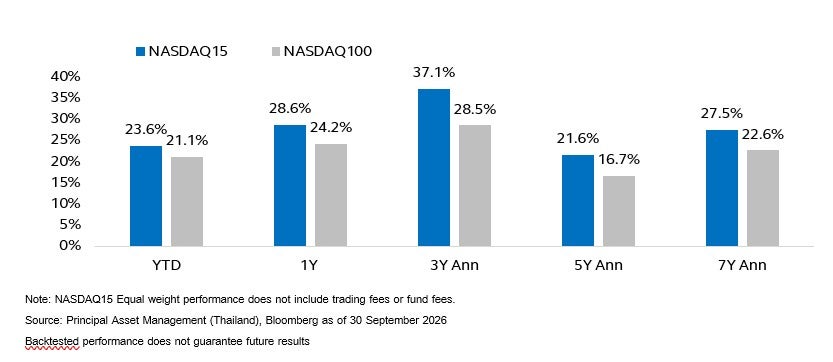
PRINCIPAL NDQ15 provides focused exposure to 15 leading companies selected from the Nasdaq universe through a transparent, rules-based investment framework. Unlike traditional market-capitalization-weighted technology strategies, which are often heavily concentrated in a small number of mega-cap stocks, the fund adopts an approximately equal-weight approach. This reduces concentration risk while allowing a broader group of innovation leaders to contribute meaningfully to portfolio performance. As a result, investors gain exposure not only to established technology leaders but also to emerging beneficiaries of structural growth trends spanning artificial intelligence, semiconductors, cloud computing, cybersecurity, digital platforms, electric vehicles, and space technology.
A key differentiator of the strategy is its quarterly portfolio review and rebalancing process. Technology leadership evolves rapidly, and history has shown that tomorrow's winners are not always today's largest companies. By reassessing portfolio constituents every quarter, the strategy seeks to maintain exposure to the most relevant beneficiaries of technological disruption while adapting to changes in industry leadership. This dynamic approach helps ensure that investors remain positioned to participate in the next generation of innovation-driven growth.
Overall, we view PRINCIPAL NDQ15 as an attractive satellite growth allocation for investors seeking diversified exposure to the AI and innovation theme. Its combination of disciplined stock selection, equal-weight portfolio construction, and systematic rebalancing offers a differentiated way to participate in long-term technological transformation while reducing dependence on a small number of mega-cap stocks.
Image
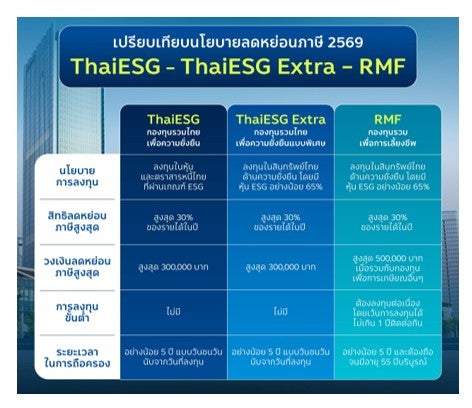
With year-end approaching, investors may also wish to consider tax-efficient investment opportunities alongside their broader portfolio allocation decisions. To this end, Principal Asset Management has identified four RMF and ThaiESG funds that not only qualify for tax benefits under applicable regulations but also align closely with our investment outlook for 2026.
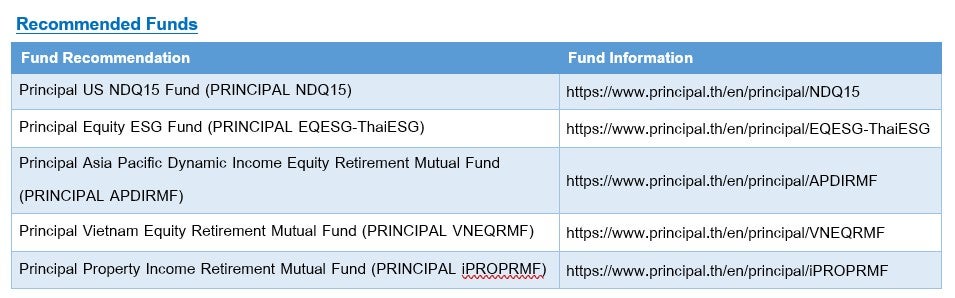
Our Recommended Tax-Saving Funds
PRINCIPAL EQESG-ThaiESG (Principal Equity ESG Fund) invests in quality Thai equities with strong ESG credentials and sustainable earnings growth. The fund is positioned to benefit from Thailand's domestic economic recovery, improving consumption trends, and long-term investment in infrastructure and technological development. Thai equity valuations remain below their long-term averages, providing scope for re-rating as earnings recover.
PRINCIPAL APDIRMF (Principal Asia Pacific Dynamic Income Equity Retirement Mutual Fund) provides exposure to AI and semiconductor opportunities across Asia Pacific through a high-conviction master fund focused on leading companies in South Korea, Taiwan, and Hong Kong. Continued spending by hyperscalers on data centers and cloud infrastructure remains supportive of the region's technology supply chain.
PRINCIPAL VNEQRMF (Principal Vietnam Equity Retirement Mutual Fund) offers exposure to Vietnam's strong structural growth story, supported by GDP growth of 8.02% in 2025 and the government's target of exceeding 10% growth during 2026-2030. Additional catalysts include the FTSE Russell upgrade to Emerging Market status, expected earnings growth of 12% in 2027, and an attractive 12-month forward P/E ratio of 10.9x, below its historical average.
PRINCIPAL iPROPRMF (Principal Property Income Retirement Mutual Fund) provides portfolio diversification and sustainable income through investments in Thai and Singapore REITs. The asset class continues to benefit from lower domestic interest rates and long-term demand for data centers and logistics facilities. The fund is actively managed and has consistently ranked in the first quartile of its peer group over the YTD, 1-year, and 3-year periods as of 23 October 2026.
Image
Source: Principal Asset Management (Thailand), data as of 30 October 2026.
For more information, please visit: www.principal.th/th/principal-taxsaving-fund
Image
Disclaimer: Investors should understand product characteristics (mutual funds), conditions of return and risk before making an investment decision./Investing in Investment Units is not a deposit and there is a risk of investment, Investors may receive more or less return investment than the initial investment. Therefore, investors should invest in this fund when seeing that investing in this fund suitable for investment objectives of investors and investors accept the risk that may arise from the investment./ The management company may apply foreign exchange risk hedging at its discretion (dynamic hedging) within a range of 0%–105% of the fund’s exposure. / PRINCIPAL NDQ15 has implemented material changes to its fund type, investment policy, investment strategy, and related conditions, following approval by the unitholders. The Fund was converted from Principal Global Education Tech Fund (PRINCIPAL GEDTECH) to Principal US NDQ15 Fund (PRINCIPAL NDQ15), with effect from 2 November 2026 onwards./ The Management Company reserves the right to change the Fund's type and special characteristics to a Feeder Fund or a Fund of Funds, or to revert the Fund to a scheme that invests directly in securities and other assets in Thailand and/or overseas, provided that such change does not result in an increase in the Fund's risk level (Risk Spectrum) or a material change in expected returns. Any such change shall be made at the discretion of the Fund Manager / PRINCIPAL NDQ15 has implemented material changes to its fund type, investment policy, investment strategy, and related conditions, following approval by the unitholders. The Fund was converted from Principal Global Education Tech Fund (PRINCIPAL GEDTECH) to Principal US NDQ15 Fund (PRINCIPAL NDQ15), with effect from 2 November 2026 onwards. / PRINCIPAL NDQ15 has highly concentrated investment in US. PRINCIPAL APDIRMF Master fund has highly concentrated investment in Taiwan and South Korea. PRINCIPAL VNEQRMF has highly concentrated investment in Vietnam. Therefore, investors should consider the overall diversification of their investment portfolio. / PRINCIPAL iPROPRMF invests in the property sector (Property Sector Fund). If adverse factors affect this sector, investors may incur significant losses. / Investors please study information about tax benefits and investment conditions in the Thai mutual fund for sustainability (Thailand ESG Fund) or investment units in Thai sustainability category (Class ThaiESG) in the investment manual in accordance with the criteria set by the Revenue Department for understanding. If investment conditions are not followed, Investors will not receive tax benefits and the tax benefits must be repaid. If in doubt, ask the investor contact person to understand before purchasing investment units. / Investors should also study information about tab benefits as specified in the investment guide in such mutual funds. If not complying with investment conditions investors will not receive tab benefits and must return tax benefits / Past performance is not indicative of future results