CIO View: July 2026
Image

Global Macro Update
Developed Markets: Resilience Despite Higher-for-Longer Rates
Developed market economies continued to demonstrate resilience through mid-2026 despite elevated geopolitical uncertainty and a more restrictive monetary environment.
In the United States, economic activity moderated modestly but remained firmly in expansion territory. Manufacturing activity softened somewhat, while services activity continued to show healthy growth. Labor-market conditions also remained relatively resilient, with unemployment remaining low despite a moderation in payroll growth. More importantly, Federal Reserve Chair Kevin Warsh reiterated the central bank's commitment to restoring inflation to its 2% target and signaled that policy would remain data-dependent, with risks increasingly skewed toward further tightening should inflationary pressures persist.
Across Europe, economic conditions have also shown signs of stabilization. Business and consumer confidence improved for a second consecutive month, while inflation moderated more quickly than expected. Consumer spending remained positive and recession concerns have eased. Nevertheless, Europe's longer-term growth outlook remains constrained by relatively weaker productivity growth and a smaller participation in the global AI investment cycle currently driving economic activity elsewhere.
Japan remains one of the brighter developed-market stories. Strong wage growth, resilient labor-market conditions, and government support measures have continued to underpin domestic consumption. Retail sales growth accelerated significantly during May, while annual wage negotiations delivered another year of meaningful pay increases. Combined with ongoing corporate governance reforms and improving shareholder returns, these developments continue to support a constructive outlook for Japan.
Taken together, developed-market growth remains positive, and recession risks appear lower than many investors anticipated at the beginning of the year. More importantly, economic resilience continues to reduce the urgency for central banks to begin easing monetary policy.
Emerging Markets: Technology-Led Divergence
Economic performance across emerging markets has become increasingly differentiated, with technology exposure, AI readiness, and participation in global supply chains emerging as key drivers of growth.
China continues to show signs of stabilization despite ongoing weakness in the property sector. Manufacturing activity has remained in expansion territory, supported by strong technology exports and AI-related demand. Services activity has also held up well, particularly in telecommunications, software, internet services, and financial industries. While domestic demand remains uneven, continued emphasis on technology innovation, industrial upgrading, and strategic infrastructure development is helping to offset structural headwinds.
South Korea remains one of the strongest beneficiaries of the global AI investment cycle. Export growth accelerated sharply during June, reaching record levels as semiconductor demand continued to surge. Although manufacturing activity has softened slightly due to supply-chain disruptions and higher input costs, Korea's position within the global AI hardware ecosystem remains a significant source of support.
India's economy continues to expand at a healthy pace, although recent indicators suggest some moderation in manufacturing and services activity amid softer external demand. Nevertheless, the country's longer-term structural growth drivers remain intact, supported by favorable demographics, rising infrastructure investment, and a large domestic consumption base.
In contrast, Australia's latest trade data highlighted the challenges facing commodity-dependent economies. A sharp decline in exports, driven primarily by lower shipments of iron ore and gold, resulted in the country's largest trade deficit in more than a decade. Similarly, Brazil experienced a modest contraction in industrial production, reflecting softer momentum in energy-related and extractive sectors.
Overall, emerging-market leadership is becoming increasingly concentrated among economies that are successfully capturing benefits from the global technology and AI investment cycle. Korea and China remain particularly well-positioned under this framework, while more commodity-dependent markets face a less supportive backdrop.
Geopolitics: Risks Have Eased, But Tensions Remain Elevated
Geopolitical risks remain elevated, and recent events serve as a reminder that the U.S.-Iran conflict remains far from fully resolved. While the mid-June framework agreement helped reduce immediate concerns surrounding a broader regional war and supported the reopening of the Strait of Hormuz, implementation has proven challenging. Recent military exchanges, renewed strikes, and attacks involving commercial shipping have highlighted the fragility of the current arrangement and the continuing risk of escalation.
For financial markets, the most important issue remains the security of energy supply routes through the Strait of Hormuz. Although shipping disruptions and military actions have recently re-emerged, markets have so far avoided returning to the extreme stress levels experienced earlier this year. Oil prices remain sensitive to developments in the region, while investors continue to monitor the possibility of supply disruptions, sanctions actions, and broader regional spillovers.
Nevertheless, we continue to believe that geopolitical developments are unlikely to become the dominant driver of global asset returns during 2H26. The probability of episodic volatility has increased, but our base case remains that policymakers on both sides retain incentives to avoid a prolonged disruption to global energy markets or a sustained regional conflict. As a result, while geopolitical headlines may continue to generate short-term market fluctuations, we expect their long-term economic impact to remain less severe than investors feared during the height of tensions earlier this year.
Thailand: Improving Economic Momentum
Thailand's outlook continues to improve gradually. The Constitutional Court's approval of the Bt400 billion emergency borrowing decree removes a significant political overhang and clears the path for both near-term economic support and longer-term investment initiatives, including clean energy development.
Inflation remains manageable. Headline inflation slowed to 2.4% year-on-year in June from 2.8% previously, helped by lower fuel prices. Meanwhile, core inflation rose to 1.2%, suggesting broader cost pressures are beginning to emerge through the economy.
External accounts remain mixed. While exports continue to grow, momentum has moderated as demand from China softened. The trade balance remains under pressure due to elevated energy imports and ongoing investment-related demand.
At the June meeting, the Bank of Thailand left its policy rate unchanged at 1.0% and maintained a supportive policy stance. Notably, policymakers appeared comfortable with a weaker baht, recognizing its beneficial impact on exports amid a weakening current-account outlook.
Taken together, recent developments reinforce our view that Thailand is experiencing a cyclical recovery supported by fiscal spending, exports, and investment activity. However, longer-term structural challenges including household debt, productivity constraints, and demographic headwinds remain important considerations for investors.
A Recommended Read: Global Market Perspectives 3Q26 – “The New Exceptionalism”
From Macro Resilience to “The New Exceptionalism”
The macroeconomic developments discussed above provide the backdrop for our investment outlook entering the second half of 2026. While growth has moderated across several economies and policymakers remain cautious amid lingering inflation risks, the global economy has once again demonstrated remarkable resilience in the face of geopolitical shocks, higher interest rates, and persistent uncertainty.
In our view, one of the most important investment frameworks for 2H26 comes from our Global Insights Team's latest Global Market Perspectives 3Q26, titled “The New Exceptionalism.” Rather than focusing on traditional market drivers such as monetary easing or fiscal stimulus, the report highlights the emergence of a new investment cycle driven by artificial intelligence, productivity gains, and unprecedented capital expenditure across digital infrastructure, energy systems, advanced manufacturing, and global technology supply chains.
A central conclusion of the report is that the AI capex cycle has evolved into the dominant force shaping global growth. What began as a technology-led investment theme has expanded into one of the largest infrastructure buildouts in modern economic history, influencing economic activity across sectors ranging from semiconductors and data centers to power infrastructure, logistics, construction, and industrial automation.
The report argues that this has created a new form of exceptionalism—centered on the United States, but increasingly extending across the broader global AI ecosystem. As a result, the key question for investors is no longer simply whether economic growth will slow or accelerate, but rather which economies, sectors, and companies are best positioned to participate in this structural investment cycle.
In my view, this is one of the most insightful investment frameworks published this year. While not every investor will agree with every conclusion, the report provides a compelling lens through which to understand many of the key trends currently shaping financial markets—from AI-related investment and U.S. productivity growth to capital flows, fixed income positioning, and the evolving leadership within global equity markets.
I would encourage readers to spend some time with the full publication, as many of the concepts are explored in considerably greater depth than can be captured in a short summary. The report can be accessed at:
https://www.principalam.com/us/insights/macro-views/global-market-perspectives-3q-2026
From our perspective, several of the themes highlighted by our Global Insights Team have particularly important implications for Thailand-based investors. In the following sections, we focus on the ideas that we believe are most relevant for portfolio construction in the current environment—namely a higher-for-longer Federal Reserve, the re-emergence of U.S. exceptionalism and U.S. dollar strength, the expanding AI-led investment cycle across Asia, and Thailand's improving cyclical outlook. Together, these themes form the foundation of our investment views and asset allocation recommendations for the remainder of 2026.
Key Global Themes and Their Implications for Thailand-Based Investors
A Fed Pause and Higher-for-Longer Interest Rates
At the start of 2026, many investors expected the Federal Reserve to begin a gradual easing cycle as inflation moderated and economic growth slowed. Six months later, the outlook looks very different.
While inflation pressures have moderated from the peaks reached earlier in the year, the U.S. economy continues to demonstrate considerable resilience. Manufacturing activity remains in expansion territory, services activity remains healthy, unemployment remains low, and AI-related investment continues to support economic growth. At the same time, the labor market has remained sufficiently firm to prevent policymakers from becoming comfortable with the inflation outlook.
Our Global Insights Team argues that the global easing cycle has largely run its course and that the Federal Reserve is likely to remain on hold, with policy risks tilted more toward tightening than easing.
We broadly agree with this assessment. Recent comments from Federal Reserve Chair Kevin Warsh reinforce the view that the Fed's focus remains firmly on returning inflation to its 2% target. Although inflation has moderated from earlier highs, policy makers appear increasingly concerned about the possibility that resilient economic growth, a tightening labor market, and continued capital spending could generate renewed inflationary pressures. In other words, the discussion is no longer centered on whether the economy requires additional support, but whether it is proving stronger than previously expected.
The rise of AI-driven investment is an important part of this story. Spending on data centers, semiconductors, power infrastructure, and digital networks has become a meaningful contributor to growth, helping offset weakness elsewhere in the economy. Rather than slowing materially, the U.S. economy has benefited from what increasingly appears to be one of the largest investment cycles in modern history.
This has important implications for investors. For much of the past decade, falling interest rates provided a significant tailwind for financial assets. We believe that environment has changed. Future returns are likely to depend more on earnings growth, productivity gains, and structural investment trends rather than monetary easing.
Recent tensions in the Middle East also create the risk of renewed energy-price volatility, which could complicate the inflation outlook and further reinforce the Federal Reserve's cautious policy stance. Our base case remains that the Federal Reserve will maintain its policy rate through 2026 and 2027. While further rate hikes are not our central expectation, we believe the next significant policy surprise is more likely to come from tighter policy than from aggressive rate cuts. Investors should therefore position portfolios for a higher-for-longer interest-rate environment rather than assume an imminent return to ultra-accommodative monetary conditions.
US Exceptionalism and a Stronger US Dollar
One of our highest-conviction views for 2H26 is that the U.S. dollar is likely to remain stronger than many investors currently expect.
Entering 2026, consensus expectations largely called for a gradual weakening of the U.S. dollar as monetary policy eased, and growth differentials narrowed. Instead, the opposite has occurred. The U.S. economy has continued to outperform most major developed economies, supported by resilient consumer spending, robust corporate earnings, healthy capital expenditure, and the rapid expansion of AI-related investment. At the same time, expectations for aggressive Federal Reserve easing have steadily receded.
In our view, the dollar's strength is no longer merely a cyclical story driven by interest-rate differentials. Increasingly, it reflects a combination of structural and cyclical factors that continue to favor U.S. assets.
The most important structural driver is productivity. The United States remains at the center of the global AI investment cycle, with spending on semiconductors, data centers, digital infrastructure, power networks, and advanced technologies supporting both productivity gains and economic growth. As these investments begin translating into higher returns on capital and stronger corporate profitability, they continue to reinforce the attractiveness of U.S. assets.
At the same time, cyclical factors remain supportive. Real and nominal interest-rate differentials continue to favor the United States, while the Federal Reserve remains considerably less dovish than many other major central banks. Even if the Fed ultimately remains on hold, the prospect of higher-for-longer policy rates should continue to support U.S. yields and reinforce the appeal of U.S. assets relative to many developed-market alternatives.
We agree with Goldman Sachs' observation that the U.S. dollar has benefited from both cyclical and structural forces. The combination of the AI investment boom and the global energy shock has strengthened the relative attractiveness of U.S. assets, supported productivity expectations, and reinforced the narrative of U.S. exceptionalism.
Standard Chartered reaches a similar conclusion, highlighting that stronger productivity growth, rising real yields, and widening policy-rate differentials continue to provide support for the dollar. In its view, the recent appreciation of the U.S. dollar reflects not only cyclical economic outperformance, but also a growing recognition that the United States is uniquely positioned to develop, finance, and commercialize many of the technologies underpinning the next phase of global growth.
For investors, this currency outlook has important portfolio implications. A stronger U.S. dollar supports our positive view on U.S. equities, technology beneficiaries, and USD-denominated assets more broadly. Conversely, we remain cautious on assets that have historically benefited from sustained periods of dollar weakness. This underpins our underweight stance on gold and our expectation that the Thai baht is likely to remain under pressure in the months ahead.
While periods of dollar weakness may occur along the way, we do not believe the conditions for a broad and sustained USD depreciation cycle are currently in place. As long as the United States remains the primary beneficiary of the AI-driven investment boom and the Federal Reserve remains reluctant to ease policy aggressively, the dollar should continue to enjoy meaningful structural support.
AI Capex Cycle and Asia’s Technology Leadership
The AI investment cycle remains the dominant force shaping global equity markets. What began as a technology-led investment theme has evolved into a broader capital expenditure cycle spanning semiconductors, data centers, power infrastructure, logistics, and advanced manufacturing. Our Global Insights Team describes this as one of the largest infrastructure buildouts in modern economic history, with effects increasingly extending well beyond the technology sector.
While the United States remains at the center of this investment boom, the benefits are increasingly flowing through Asia's deeply integrated technology supply chains. The report notes that Asia's technology leadership has also helped cushion the region from recent geopolitical and energy-related shocks, creating a clear divergence between economies directly linked to the AI ecosystem and those that are less exposed.
Our Asia Equities team believes investors remain highly focused on the sustainability of the AI capex cycle and continue to monitor whether spending by hyperscalers can be maintained. While recent earnings results from selected semiconductor companies have led to bouts of volatility, the debate increasingly centers on the pace of earnings upgrades and the sustainability of market expectations rather than the durability of underlying AI demand. In our view, recent weakness in parts of the semiconductor sector reflects rotation and positioning rather than the end of the cycle.
Within Asia, Korea and Taiwan remain among the most important beneficiaries of demand for advanced semiconductors, high-performance computing, and AI infrastructure. Continued investment in computing capacity, coupled with ongoing supply constraints, suggests that demand for AI-related hardware remains structurally strong.
At the same time, recent market performance has been exceptionally strong, particularly in Korea where a significant portion of gains has been driven by a relatively narrow group of AI-related and semiconductor stocks. As a result, investor positioning has become increasingly crowded and market volatility has risen. While we remain constructive on the long-term AI investment cycle, we believe investors should distinguish between maintaining exposure to the structural theme and chasing short-term market momentum.
We are also constructive on selected areas of the Chinese market. While domestic economic conditions remain mixed, China's strengths in technology innovation, advanced manufacturing, power infrastructure, autonomous systems, and semiconductor self-sufficiency continue to improve. We believe these structural themes, together with continued policy support for industrial upgrading and strategic industries, should create attractive opportunities for long-term investors.
We also continue to view Vietnam favorably from a long-term economic perspective. Vietnam continues to benefit from strong manufacturing activity, FDI inflows, supply-chain diversification, and a recovery in international tourism. Economic growth remained robust during the first half of the year, supported by manufacturing, exports, and continued implementation of foreign direct investment projects. That said, our view on the equity market is more balanced at current levels. While the macroeconomic backdrop remains supportive, valuations have become less compelling following the market's strong performance and foreign investors have remained net sellers. As a result, we continue to view Vietnam as an attractive long-term structural growth story while maintaining a neutral stance on Vietnamese equities in the near term.
The key takeaway is that AI should no longer be viewed simply as a technology theme. Instead, it represents a multi-year investment cycle with implications across industries, supply chains, and capital markets. For investors, this reinforces our constructive outlook on Asia's technology and innovation ecosystem. Korea and Taiwan remain important participants in the global AI buildout, China offers exposure to industrial upgrading and technology innovation, while Vietnam continues to stand out as one of ASEAN's most compelling long-term growth stories. In our view, the opportunity today lies less in making concentrated single-country bets and more in maintaining diversified exposure to the broader AI and technology investment cycle unfolding across the region.
Thailand: A Cyclical Recovery Story
Thailand's investment case differs from many of the themes driving global markets today. While the United States remains at the center of the AI investment boom and North Asia continues to benefit directly from the semiconductor and technology supply chain, Thailand's opportunity is primarily cyclical in nature.
The outlook for the Thai economy has improved meaningfully since the beginning of the year. Export activity remains supportive, investment spending has strengthened, and fiscal stimulus has become increasingly visible. In particular, the approval of the Bt400 billion fiscal package removes a significant policy overhang and should provide support for both near-term economic activity and longer-term investment initiatives, including infrastructure and energy-related projects.
Recent data also suggest that investment is becoming a more important driver of economic activity. Industrial development, digital infrastructure projects, data centers, clean energy investment, and manufacturing-related capital expenditure are contributing to a broader improvement in sentiment toward the economy. At the same time, the Bank of Thailand has maintained an accommodative stance, leaving policy rates unchanged and signaling comfort with a weaker baht as a mechanism to support exports and growth.
The improved economic backdrop has been reflected in upward revisions to growth expectations during the year. While growth remains moderate relative to regional peers, the direction of change is becoming more important than the absolute level. Fiscal support, investment activity, and improving external demand are all contributing to a more constructive environment than many investors anticipated earlier in the year.
For equity investors, the key implication is that market performance is likely to be driven less by broad macro growth and more by sectors exposed to investment and capital formation. We continue to favor themes linked to industrial development, infrastructure spending, power and utilities, digital infrastructure, and selected financial institutions positioned to benefit from improving investment activity. We also remain constructive on businesses leveraged to the ongoing recovery in tourism and services-related activity.
In our view, Thailand does not need to become the next AI leader to generate attractive investment opportunities. As long as exports remain supportive, investment activity continues to strengthen, and fiscal stimulus gains traction, the cyclical backdrop for Thai equities should remain constructive through the second half of 2026.
Malaysia Fixed Income: Diversifying Beyond Thailand
For Thailand-based investors, Malaysia remains one of the more interesting fixed-income markets in the region.
While we are not making an aggressive duration call, we believe Malaysian fixed income offers a differentiated combination of economic resilience, policy stability, and attractive income characteristics that are increasingly difficult to find elsewhere in Asia. Industrial production accelerated to 8.2% year-on-year in April, supported by broad-based strength across manufacturing industries, while exports reached record highs for an eleventh consecutive month, driven in part by demand for AI-related and automotive technologies. At the same time, inflation remains contained at around 2%, and labor market conditions continue to reflect near full employment.
From a Thai investor's perspective, the appeal of Malaysia lies less in the prospect of significant capital gains and more in the stability of the underlying environment. Malaysia currently enjoys stronger economic growth, lower inflation, and a more favorable fiscal trajectory than many regional peers. Combined with a relatively predictable monetary policy environment and a policy rate that remains meaningfully above Thailand's, this creates an attractive backdrop for income-oriented investors.
This becomes increasingly relevant in the context of our expectation that the Bank of Thailand will maintain its policy rate at 1.0% throughout 2026 and 2027. With domestic rates likely to remain low and Thai fixed-income returns increasingly driven by carry rather than capital gains, diversification into Malaysia provides exposure to a higher-yielding fixed-income market supported by stronger industrial momentum and robust export growth. In our view, Malaysian fixed income can therefore play an important role in enhancing portfolio income while maintaining exposure to a familiar Asian market.
Within the market, we continue to favor high-quality corporate bonds over broad duration exposure. Our Malaysian Fixed Income team maintains a preference for investment-grade issuers, particularly domestically oriented companies with resilient cash flows, healthy balance sheets, and strong underlying fundamentals. By contrast, we remain more selective on government bonds, where valuation support appears less compelling and term premia remain relatively compressed.
In an environment where the global easing cycle has largely run its course and fixed-income returns are increasingly driven by income rather than duration gains, we continue to see value in the broader Malaysian fixed-income market, particularly within high-quality corporate credit. For Thailand-based investors seeking to enhance portfolio income without materially increasing risk, Malaysia remains an attractive option for diversifying beyond domestic fixed-income markets.
Private Credit: Turning a Structural Opportunity into Sustainable Income
Private credit remains one of our highest-conviction investment themes for the medium term. While recent headlines surrounding parts of the industry have led some investors to question the asset class, we believe the more important conclusion is that private credit is increasingly becoming a manager-selection story rather than an asset-allocation story.
The long-term growth case for private credit remains intact. Principal's latest Global Market Perspectives continues to highlight resilient corporate fundamentals, healthy earnings growth, and limited signs of systemic stress across credit markets. At the same time, Goldman Sachs argues that the AI investment cycle is generating a significant increase in financing requirements across infrastructure, power, data centers, and industrial capacity. Together, these developments suggest that demand for private capital should remain supportive over the medium term.
Importantly, we do not view today's private credit opportunity in the same way investors may have viewed it five years ago. As the asset class has matured, performance dispersion between managers has widened. Principal Alternative Credit has repeatedly emphasized that the key distinction is no longer between public and private lending, but between disciplined lenders and asset gatherers. In our view, not all private credit opportunities are created equal.
We remain most constructive on lower and core middle-market direct lending, where lenders continue to enjoy stronger covenant protections, more attractive spreads, and less competitive pressure than in the upper-middle-market segment. This contrasts with some of the larger areas of the industry where rapid asset growth has increased competition, compressed spreads, and encouraged weaker lending structures. Principal's direct lending team has been particularly cautious on covenant-lite transactions, highly leveraged structures, and certain forms of asset-based lending tied primarily to enterprise value rather than recurring cash flow.
The investment case is further strengthened by the broader capital expenditure cycle currently underway. As businesses continue investing in digital infrastructure, industrial modernization, logistics networks, and energy-related projects, financing demand should remain elevated. In many cases, private lenders are increasingly positioned to provide financing solutions that traditional banking channels are less willing or able to accommodate.
For Thailand-based investors, private credit also offers an attractive source of portfolio diversification. In an environment where public fixed-income returns are increasingly driven by carry and policy rates remain relatively low, private credit provides access to an additional source of income that is less dependent on public market movements. While the asset class requires careful manager selection and a longer investment horizon, the potential for attractive risk-adjusted income remains compelling.
In our view, the most important takeaway is that recent market volatility has not changed the long-term opportunity set. Rather, it has reinforced the importance of underwriting quality, covenant discipline, and manager selection. We therefore remain constructive on private credit, particularly strategies focused on lower and middle-market direct lending, where we continue to see an attractive balance between income generation and credit risk.
Putting It All Together for Thailand-Based Investors
While many of the themes discussed throughout this report are global in nature, investment decisions are ultimately made within a local context. For Thailand-based investors, the challenge is not simply identifying the most compelling opportunities globally, but determining how those opportunities fit within portfolios that are naturally anchored to domestic assets, local interest rates, and regional investment opportunities.
Taken together, our key themes for 2H26—a higher-for-longer Federal Reserve, renewed U.S. exceptionalism, sustained U.S. dollar strength, the ongoing AI capex cycle, Thailand's cyclical recovery, attractive opportunities in Malaysian fixed income, and the continued evolution of private credit—point toward a portfolio that remains constructive on risk assets while emphasizing diversification across geographies, asset classes, and sources of return.
The fund recommendations below represent our preferred implementation of these views for Thailand-based investors as we navigate the remainder of 2026.
Image
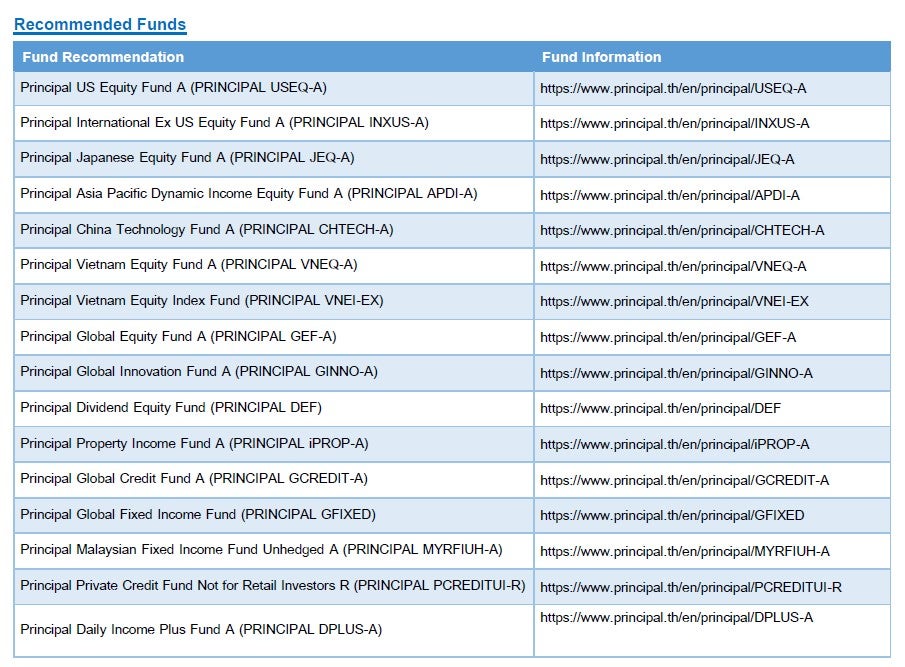
Disclaimer: Investors should understand the characteristics of the fund, investment conditions, potential returns, and risks before making an investment decision. PRINCIPAL USEQ, PRINCIPAL GEF, PRINCIPAL GINNO, and PRINCIPAL GCREDIT invest in underlying funds concentrated in the United States; PRINCIPAL MYRFIUH invests in an underlying fund concentrated in Malaysia; PRINCIPAL CHTECH invests in an underlying fund concentrated in China; PRINCIPAL JEQ invests in an underlying fund concentrated in Japan; PRINCIPAL APDI invests in underlying funds concentrated in Taiwan and South Korea; and PRINCIPAL VNEQ and PRINCIPAL VNEI invest in Vietnam. Investors should consider the overall diversification of their investment portfolios. PRINCIPAL iPROP is concentrated in the property sector and may be significantly affected by adverse developments in such sector. PRINCIPAL DPLUS may invest up to 79% of its NAV in foreign assets and therefore may be exposed to foreign exchange risk; however, the fund is fully hedged against currency risk (95%-105% of exposure). PRINCIPAL MYRFIUH is unhedged and may be subject to foreign exchange fluctuations, which could result in losses or returns lower than the initial investment. PRINCIPAL PCREDITUI is a high-risk or complex fund available only to Institutional Investors and Ultra Accredited Investors as defined by the SEC. The Management Company may use derivatives for foreign exchange risk management at its discretion, and certain funds may adopt a dynamic hedging policy ranging from 0%-105% of exposure. Funds investing overseas may be exposed to currency risk, and investors may incur gains or losses from exchange rate movements or receive proceeds lower than their initial investment. Past performance is not indicative of future results.