CIO View: August 2026
Image

Macro Update
Global financial markets navigated another month of heightened uncertainty as investors balanced escalating geopolitical tensions in the Middle East, evolving monetary policy expectations, and signs of moderating economic growth across major economies. While market volatility has increased, our core investment conviction remains unchanged: long-term investors should remain focused on resilient corporate fundamentals, structural growth drivers, and the opportunities created by periodic market dislocations.
Economic data released during the month presented a mixed picture for the U.S. economy. Labor market indicators pointed to continued cooling, with July nonfarm payrolls unexpectedly declining by 23,000 jobs, marking the first notable contraction in recent months. Weakness was evident across several sectors, including local government education, retail, financial services, and leisure and hospitality. In addition, the labor force participation rate declined to its lowest level in more than five years, suggesting weakening labor market momentum. Wage growth continued to moderate, further supporting the view that domestic demand pressures are easing.
Inflation data, however, provided some reassurance to policymakers and investors. Headline consumer price inflation eased to 3.4% year-on-year in July from 3.5% in the previous month, while core inflation slowed further to 2.5%. Although inflation remains above the Federal Reserve's long-term target, the continued moderation supports expectations that policy rates may remain on hold unless inflationary pressures reaccelerate.
The U.S. Federal Reserve maintained the federal funds rate at 3.50%-3.75%, though the overall policy stance remained distinctly hawkish. The decision revealed a rare 9-3 voting split, with three policymakers favoring an immediate rate increase, underscoring continued concerns regarding inflation persistence. Meeting minutes indicated that while inflation has moderated, policymakers remain cautious about upside risks stemming from tariffs, elevated energy prices, geopolitical instability, and continued investment related to artificial intelligence infrastructure.
While labor market conditions have softened, Fed Chair Kevin Warsh reiterated the Federal Reserve's commitment to achieving its 2% inflation objective and emphasized that future policy actions will remain data dependent. Although this approach preserves policy flexibility, the absence of explicit forward guidance has reduced visibility into the Fed's reaction function and contributed to elevated Treasury market volatility. Investors are increasingly demanding additional compensation for policy uncertainty and the possibility that inflation proves more persistent than currently expected.
Meanwhile, the U.S. Treasury announced plans to increase long-dated bond buyback operations beginning in September. Buyback sizes for 10- to 30-year maturities will at least double from current levels, reflecting efforts to enhance market liquidity and reduce volatility in the Treasury market. Importantly, officials stressed that the program will not alter the government's regular debt issuance schedule, suggesting that the initiative is intended primarily to improve market functioning rather than materially alter fiscal funding strategies.
Treasury Secretary Scott Bessent's decision initially provided support for longer-dated Treasury securities and temporarily eased upward pressure on yields. However, the positive impact proved short-lived as investors concluded that buybacks alone were insufficient to address broader concerns surrounding fiscal deficits, rising government debt burdens, and lingering inflation uncertainty. Consequently, long-term Treasury yields resumed their upward trend, reinforcing the view that bond investors continue to require a higher term premium despite signs of moderating economic growth.
The policy debate intensified further at the Jackson Hole Symposium over the weekend. Fed Chair Kevin Warsh delivered a notably hawkish message, emphasizing that restoring price stability remains the Federal Reserve's foremost objective and warning that recent moderation in inflation has not yet provided sufficient evidence of a sustained return toward the Fed's 2% target. While acknowledging that artificial intelligence investment, healthy corporate profitability, resilient consumer spending, accommodative credit conditions, and a labor market operating near full employment continue to support economic activity, Warsh stressed that AI-driven productivity gains cannot replace monetary policy as a tool for addressing near-term inflation pressures. He reiterated that future policy decisions will remain data dependent and declined to provide explicit forward guidance. Markets interpreted the speech as meaningfully hawkish, with Treasury yields moving higher and rate expectations repricing sharply. According to CME FedWatch data, the probability that the Federal Open Market Committee remains on hold through its December 2026 meeting declined to 11% from 28% just one week earlier, while the probability of rates remaining unchanged over the next twelve months fell to only 4% from 12%.
In our view, these shifts indicate that market expectations for at least one additional rate hike have risen materially following Jackson Hole. The symposium has also increased our own assessment of the likelihood that further policy tightening may ultimately be required. While Principal's Global Insights team has not yet formally revised its central policy outlook, recent Fed communications, culminating in Jackson Hole, have strengthened the case for an upside risk to rates relative to our previous assessment. Moreover, central banks typically avoid delivering such explicit inflation-focused messaging unless they are prepared to follow through with policy action if necessary. As a result, should inflation remain stubbornly above target, the risk of more than one additional rate increase may be higher than markets had previously anticipated, as policymakers will also seek to preserve the credibility of their commitment to price stability.
Beyond monetary policy, geopolitical developments became a major market focus during the month. Renewed tensions between the United States and Iran, including attacks on commercial shipping routes in the Red Sea and Gulf of Oman, have increased concerns regarding energy security and global supply chains. The U.S. administration's Operation Economic Outcast has further intensified pressure on Iran through expanded sanctions targeting key sectors including shipping, aviation, technology, precious metals, and financial networks.
With the expiration of previous ceasefire arrangements and continued uncertainty surrounding the Strait of Hormuz, markets have begun pricing a higher geopolitical risk premium into crude oil prices. While financial markets have thus far avoided a broad risk-off response, energy prices remain a critical variable. A sustained increase in oil prices could complicate the global disinflation process and potentially delay monetary easing across several regions.
Across other major economies, central banks largely maintained existing policy settings while monitoring inflation and growth developments. The European Central Bank left interest rates unchanged but maintained a cautious tone given the inflation implications of higher energy prices. The Bank of Japan also held rates steady, although a dissenting vote in favor of further tightening highlighted growing concerns over domestic inflation pressures. Meanwhile, the People's Bank of China maintained an accommodative stance aimed at supporting economic activity and stabilizing demand as the economy continues to navigate structural challenges.
In Thailand, economic conditions remained subdued despite pockets of resilience. Second-quarter GDP growth slowed to 1.9% year-on-year from 2.8% in the first quarter, while seasonally adjusted GDP contracted 0.2% quarter-on-quarter, raising concerns that the economy could slip into a technical recession should weakness persist into the third quarter. Domestic demand remained constrained by elevated household debt, higher living costs, and fragile consumer confidence.
Nevertheless, several areas of the economy continued to demonstrate strength. Private investment expanded by an impressive 13.4% year-on-year, supported by continued investment in electronics manufacturing, AI-related infrastructure, data centers, and projects promoted by Thailand's Board of Investment (BOI). Export activity also remained robust, with first-half export growth reaching 17.6%, benefiting from strong external demand and supply-chain diversification trends.
While some of the recent export strength may reflect front-loading ahead of potential tariff changes, the investment cycle underway in areas such as electronics, digital infrastructure, and data-center development reinforces our constructive longer-term view on Thailand's role within global technology supply chains. Reflecting stronger-than-expected investment and export activity, the National Economic and Social Development Council (NESDC) revised its 2026 GDP growth forecast upward to a range of 2.0%-2.5%.
However, the broader outlook remains challenging. Elevated energy prices, geopolitical uncertainty, weak household spending, high debt burdens, and a slower-than-expected recovery in tourism are likely to continue weighing on growth. As a result, Thailand's near-term economic trajectory is expected to remain highly dependent on external demand, foreign investment inflows, and continued progress in strategic sectors linked to technology, digitalization, and artificial intelligence infrastructure.
Taken together, current market developments reinforce a key theme from our Mid-Year Investment Outlook. Markets are gradually transitioning from a period dominated by interest-rate expectations toward one increasingly driven by corporate earnings, business fundamentals, and long-term structural growth trends. While policy uncertainty and geopolitical risks may continue to create short-term volatility, the fundamental drivers of global equity returns remain intact.
Investment Recommendation
The current environment reinforces our preference for global equities. While investors continue to face uncertainty related to geopolitics, inflation, fiscal sustainability, and the future path of monetary policy, several important positives remain firmly in place. Global earnings growth continues to exceed expectations, corporate balance sheets remain healthy, and investment related to artificial intelligence continues to accelerate across multiple industries. Recent results from NVIDIA provided further evidence that AI adoption remains in a powerful expansion phase, with quarterly revenue more than doubling year-over-year to a record $96 billion, Data Center revenue rising 117%, and management guiding to further growth next quarter despite assuming no contribution from China.
Importantly, AI is no longer a semiconductor-only story. NVIDIA's results highlighted strong demand not only from hyperscalers but also from enterprises, AI-native companies, sovereign customers, and infrastructure providers, while AI-related capital spending continues to expand across cloud infrastructure, software, cybersecurity, digital services, automation, and productivity-enhancing technologies. This broadening investment cycle suggests that the beneficiaries of AI extend well beyond chip manufacturers and into a much wider set of industries across the global economy.
Against this backdrop, we continue to recommend Principal Global Equity Fund A (PRINCIPAL GEF-A) as the preferred core global equity allocation. The fund provides diversified exposure across regions, sectors, and investment styles, allowing investors to participate in global growth opportunities while reducing dependence on any single market or investment theme. As markets become increasingly earnings-driven, diversified exposure to high-quality global businesses with strong competitive advantages, healthy cash flows, and enduring growth prospects remains particularly attractive.
Image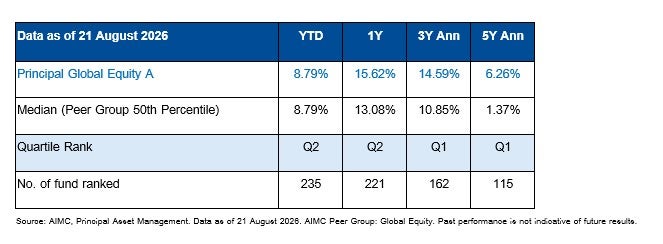
For investors seeking additional long-term growth potential, we continue to recommend Principal Global Innovation Fund A (PRINCIPAL GINNO-A) as a complementary allocation. The fund focuses on companies benefiting from innovation, disruptive technologies, changing consumer behaviors, and long-term structural trends. The investment case for innovation remains compelling as artificial intelligence adoption continues to accelerate globally. Recent industry developments suggest that AI infrastructure investment remains in the early stages of a multi-year buildout cycle, with spending increasingly supported by enterprises, sovereign initiatives, cloud providers, software developers, and emerging AI business models. We believe many of the beneficiaries of this transformation remain underappreciated, creating opportunities across sectors that extend well beyond the technology industry itself.
Image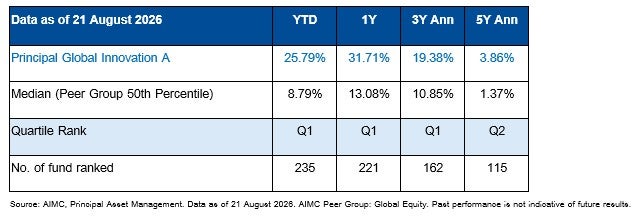
Our message remains consistent with the views we outlined earlier this year. We are no longer in a market primarily driven by expectations of low-interest rate environment. Increasingly, market leadership is being determined by earnings growth, innovation, productivity gains, and corporate execution. The latest earnings season, including particularly strong results from AI-related leaders, continues to demonstrate that companies delivering tangible revenue and profit growth are being rewarded by investors
Accordingly, we continue to view PRINCIPAL GEF-A as the preferred core allocation for diversified participation in global equity markets, while PRINCIPAL GINNO-A remains the preferred satellite allocation for investors seeking greater exposure to innovation, artificial intelligence, and other long-term growth opportunities. Together, these strategies provide a balanced approach to capturing both the breadth of global economic growth and the transformational opportunities arising from the next phase of technological advancement
Image Image
Image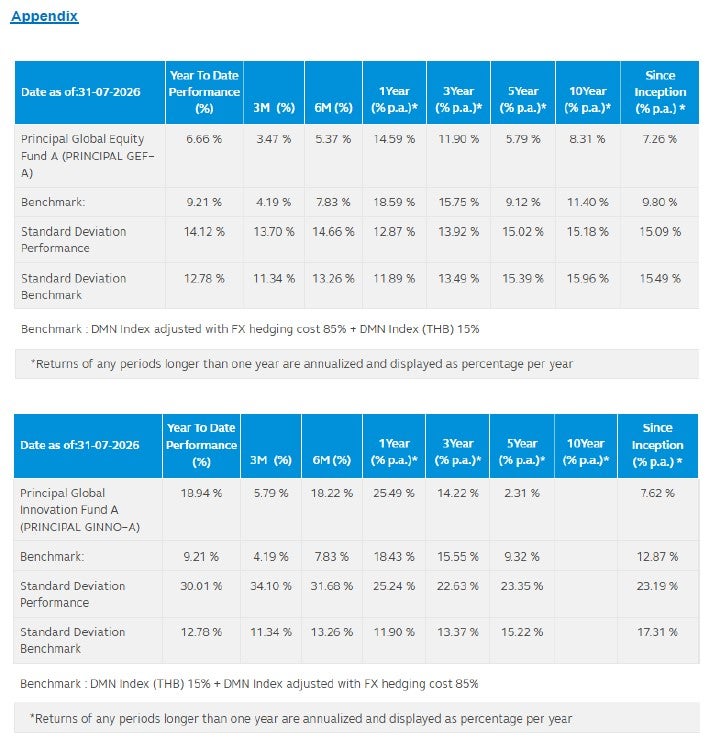
Disclaimer: Investors should understand the characteristics of the fund, investment conditions, potential returns, and risks before making an investment decision. PRINCIPAL GEF, PRINCIPAL GINNO invest in underlying funds concentrated in the United States. The Management Company may use derivatives for foreign exchange risk management at its discretion, and certain funds may adopt a dynamic hedging policy ranging from 0%-105% of exposure. Funds investing overseas may be exposed to currency risk, and investors may incur gains or losses from exchange rate movements or receive proceeds lower than their initial investment. Past performance is not indicative of future results/ Investors are advised to review the performance of each unit class of the Fund at https://www.principal.th/th/mutual-fundth before making any investment decision.