CIO View: September 2026
Image

Macro Update: A Higher-for-Longer World Becomes Reality
September marked an important turning point for financial markets as several of the themes highlighted in our Mid-Year Outlook became increasingly visible in policy decisions and asset prices.
The combination of escalating geopolitical tensions, rising energy prices, and resilient economic activity reinforced the view that the global economy is entering a more sustained higher-for-longer interest-rate environment. The most significant development during the month was the increasingly synchronized hawkish shift among major central banks, alongside a renewed focus on inflation risks stemming from the ongoing conflict between the United States and Iran.
Geopolitical developments remained a key driver of market sentiment throughout the month. The conflict between the United States and Iran continued to intensify, with military actions targeting regional assets and energy infrastructure around the Strait of Hormuz. The resulting concerns over potential disruptions to global energy supplies pushed oil prices meaningfully higher and contributed to a rise in inflation expectations across major economies. Although financial markets generally remained resilient, investors increasingly focused on the implications for monetary policy and the risk that central banks may need to maintain restrictive policy settings for longer than previously expected.
In the United States, the Federal Reserve raised the federal funds rate by 25 basis points to 3.75%-4.00% at the September Federal Open Market Committee (FOMC) meeting, marking its first rate increase in more than three years. The unanimous decision reflected the Fed's assessment that economic growth, labor market conditions, and inflation remain stronger than previously anticipated. Updated projections showed higher growth forecasts, lower unemployment expectations, and inflation remaining above target through 2028, with inflation not expected to return to the Fed's 2% objective until 2029.
Importantly, the September decision also marked a notable shift in our Global Insights Team's policy outlook. Earlier this year, the team's base case called for the Federal Reserve to remain on hold throughout 2026 and 2027. Today, the outlook has evolved materially. Our Global Insights Team now expects two rate hikes in 2026, one of which was delivered in September, followed by an extended pause through 2027. While the base case remains for one additional 25 basis point increase in December, the debate has shifted from whether rates will rise again to how many additional increases may ultimately be required. With inflation expected to remain above target for an extended period, further tightening in 2027 cannot be ruled out should second-round inflationary effects emerge or renewed escalation in the Iran conflict result in materially higher energy prices.
At the same time, President Donald Trump and Treasury Secretary Scott Bessent have publicly advocated lower borrowing costs and easier financial conditions. Treasury buyback operations intended to support bond market liquidity initially lowered long-term yields but were unable to sustain the decline as investors continued to focus on inflation risks, fiscal deficits, debt sustainability, and the longer-term ability of policymakers to keep inflation expectations anchored. As a result, U.S. Treasury yields remained elevated throughout the month.
Outside the United States, major central banks broadly maintained a tightening bias. The European Central Bank raised all three policy rates by 25 basis points in September, marking its second rate increase since the start of the Iran conflict. The decision was unanimous and accompanied by upward revisions to inflation forecasts, with inflation now expected to remain above target through 2027. While ECB President Christine Lagarde refrained from providing forward guidance and reiterated a meeting-by-meeting approach, our Global Insights Team expects another ECB rate hike before year-end and sees the possibility of further tightening in 2027 should elevated energy prices continue to support inflation pressures.
Meanwhile, the Bank of Japan accelerated its policy normalization process by raising its policy rate by 25 basis points to 1.25%, bringing borrowing costs to their highest level since 1995 and marking its second hike in three months. The decision reflected concerns over persistent inflation pressures, higher energy prices, and continued yen weakness following the recent Federal Reserve rate hike. Markets are increasingly focused on the eventual terminal rate, with economists estimating Japan's nominal neutral rate at approximately 1.1%-2.5% and consensus expectations pointing to policy rates reaching around 1.5% by March 2027.
China remains a notable exception to the broader tightening trend. The People's Bank of China maintained its accommodative stance, leaving policy rates unchanged while continuing to support economic activity through abundant liquidity and targeted policy measures. Although manufacturing activity has stabilized, domestic demand remains relatively subdued, reinforcing the view of a two-speed economy balancing structural challenges with selective areas of industrial and technological strength.
Recent economic data continued to demonstrate the resilience of the U.S. economy. August nonfarm payrolls increased by 162,000, materially above expectations, while the unemployment rate remained stable at 4.1%. Retail sales also surprised positively, highlighting the continued strength of household consumption. Inflation, however, remains elevated, with headline CPI holding at 3.4% year-over-year. Taken together, the data support the Federal Reserve's assessment that economic activity remains sufficiently robust to tolerate tighter monetary conditions.
Economic activity across Europe and Japan similarly remained resilient despite increasing external headwinds. The euro area economy expanded by 0.6% quarter-over-quarter in the second quarter, its strongest pace of growth since 2022, supported by exports and improving household consumption. Japan recorded its third consecutive quarter of growth, benefiting from government spending, business investment, and resilient external demand.
Domestically, Thailand remains one of the few major economies where monetary policy continues to be accommodative. The Monetary Policy Committee maintained the policy rate at 1.00%, noting that exports and private investment continue to benefit from the global technology and AI investment cycle while overall economic growth remains uneven. In addition, severe flooding across Bangkok and several surrounding provinces over the past week has emerged as a new near-term economic risk, disrupting transportation, commerce, and business activity in some affected areas. While the full economic impact is still being assessed, early estimates suggest that the overall effect on national GDP should remain relatively contained given the localized nature of the disruptions and expectations that activity will normalize as floodwaters recede. Nevertheless, the event reinforces our view that any near-term policy rate hikes by the Bank of Thailand are effectively off the table, as policymakers are likely to prioritize supporting economic recovery and mitigating downside risks to domestic demand.
On the fiscal side, the government's approval of Phase 2 of the Thai Chuay Thai Plus program should help mitigate the impact of higher energy prices and support domestic consumption during the final quarter of the year. Preliminary estimates from local economists suggest the recent flooding could create short-term disruptions to commerce, services, and transport activity, although current assessments indicate that nationwide economic damage is likely to remain manageable relative to overall GDP.Taken together, September's developments reinforced a central conclusion of our Mid-Year Outlook: the world is increasingly transitioning toward a higher-for-longer policy regime. The combination of resilient economic activity, ongoing AI-driven investment, higher energy prices, and persistent inflation pressures suggests that the era of ultra-accommodative monetary policy is likely behind us. For investors, this reinforces the importance of portfolio diversification, quality earnings growth, and assets capable of generating sustainable income in an environment where interest rates are likely to remain structurally higher than many market participants had expected earlier in the year.
Investment Implications: Positioning for a Higher-for-Longer Regime
The developments observed during September reinforce our conviction that the broader investment landscape continues to be shaped by resilient economic growth, the AI-driven capital expenditure cycle, and a structurally higher interest-rate environment. While geopolitical developments and rising bond yields have contributed to periods of market volatility, the underlying drivers of corporate earnings and economic activity remain largely intact.
Our core investment convictions therefore remain unchanged.
We continue to believe that global monetary policy has entered a higher-for-longer regime. Recent rate hikes by the Federal Reserve, the European Central Bank, and the Bank of Japan reinforce the view that policymakers remain focused on containing inflation and ensuring inflation expectations remain anchored. As a result, investors should not expect a return to the exceptionally accommodative policy conditions that characterized much of the post-Global Financial Crisis period.
At the same time, we continue to see evidence of U.S. exceptionalism. Strong productivity growth, resilient consumer spending, healthy corporate balance sheets, and sustained investment in artificial intelligence continue to support the U.S. economy relative to many developed-market peers. These factors remain supportive of the U.S. dollar and continue to reinforce the role of U.S. assets within global portfolios.The AI capex cycle remains one of the most important structural drivers of global growth. What began as a technology investment theme has expanded into a broader ecosystem involving semiconductors, data centers, power infrastructure, industrial automation, and digital connectivity. While AI remains a powerful driver of returns, market leadership is gradually broadening beyond technology into selected financial, healthcare, and industrial sectors that are also benefiting from the investment cycle.
Within equities, we remain constructive and continue to favor companies with strong earnings growth, healthy balance sheets, robust free-cash-flow generation, and disciplined capital management. We believe opportunities remain particularly attractive in areas linked to AI infrastructure, semiconductor demand, digital transformation, and productivity-enhancing technologies. Beyond technology, we also see increasing opportunities in selected financials, healthcare companies, and industrial businesses that exhibit strong earnings visibility and attractive valuations.
Asia remains an important source of long-term investment opportunities. Many Asian markets provide exposure to globally competitive technology companies, improving corporate governance standards, strong earnings growth, and attractive relative valuations. We therefore continue to favor diversified exposure to Asia's technology ecosystem and broader regional growth opportunities.
Within fixed income, our preference remains focused on income and carry rather than duration. While higher bond yields have improved prospective returns across fixed-income markets, persistent inflation risks, fiscal concerns, and policy uncertainty suggest continued caution toward long-duration government bonds. Instead, we continue to favor high-quality corporate credit and income-oriented fixed-income strategies where investors are adequately compensated for taking credit risk.
Importantly, corporate fundamentals remain healthy despite higher borrowing costs. Strong balance sheets, resilient earnings, and improving cash-flow generation continue to support credit markets and provide a constructive backdrop for quality fixed-income investments.
Overall, the global investment environment remains supported by resilient growth, the AI-driven capex cycle, and healthy corporate earnings. While rising bond yields and geopolitical uncertainty may lead to periods of volatility, we believe the most compelling long-term opportunities remain concentrated in quality equities, income-generating credit, and Asia's technology ecosystem. As a result, we remain constructive on risk assets over the medium to long term while maintaining a disciplined focus on quality, diversification, and sustainable sources of return.
Investment Ideas for a Higher-for-Longer World
The current environment reinforces our preference for global equities. While investors continue to face uncertainty related to geopolitics, inflation, fiscal sustainability, and the future path of monetary policy, several important positives remain firmly in place. Global earnings growth continues to exceed expectations, corporate balance sheets remain healthy, and investment related to artificial intelligence continues to expand across a growing number of industries.
Recent results from NVIDIA provided further evidence that the AI investment cycle remains in a powerful expansion phase. Quarterly revenue more than doubled year-over-year to a record US$96 billion, while Data Center revenue increased 117%. Management also guided to further growth in the coming quarter despite assuming no contribution from China. These results reinforce our view that the AI capex cycle remains one of the most important structural drivers of global growth and investment today.
Importantly, AI is no longer solely a semiconductor story. Recent earnings results continue to highlight strong demand not only from hyperscalers, but also from enterprises, sovereign customers, software providers, cybersecurity firms, infrastructure operators, and a growing ecosystem of AI-enabled businesses. As a result, the beneficiaries of this investment cycle extend well beyond chip manufacturers and increasingly encompass a much broader segment of the global economy.
Against this backdrop, we continue to recommend Principal Global Equity Fund A (PRINCIPAL GEF-A) as our preferred core global equity allocation. The fund provides diversified exposure across regions, sectors, and investment styles, allowing investors to participate in global growth opportunities without excessive dependence on any single country, sector, or investment theme. As markets become increasingly driven by earnings growth, productivity improvements, and corporate execution, diversified exposure to high-quality global businesses with sustainable competitive advantages remains particularly attractive.
Image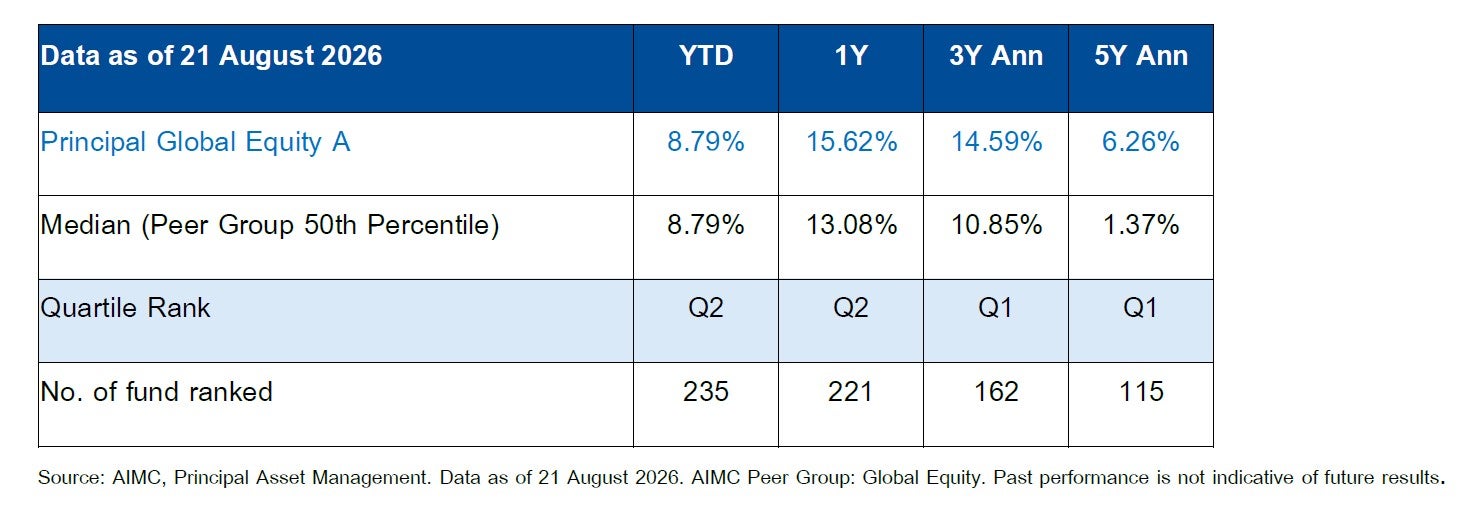
For investors seeking additional long-term growth potential, we continue to recommend Principal Global Innovation Fund A (PRINCIPAL GINNO-A) as a complementary allocation. The fund focuses on companies benefiting from innovation, disruptive technologies, evolving consumer behaviors, and long-term structural trends.We continue to believe the investment case for innovation remains compelling. The ongoing expansion of AI infrastructure, cloud computing, automation, digital services, and productivity-enhancing technologies suggests that investment associated with artificial intelligence remains in the early stages of a multi-year growth cycle. As adoption broadens across industries and geographies, we believe many long-term beneficiaries remain underappreciated by investors, creating attractive opportunities beyond the traditional technology sector.
Image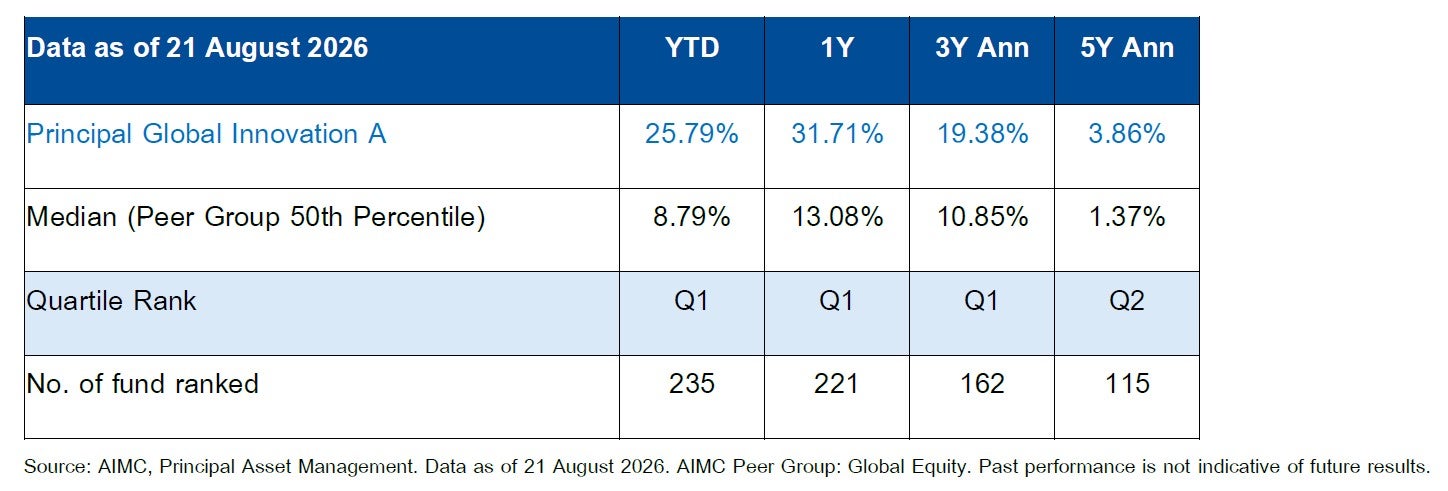
While global equities remain our preferred asset class, the shift toward a higher-for-longer interest rate environment has also improved the relative attractiveness of fixed income. Higher yields today provide investors with significantly more income than was available during much of the past decade, while resilient economic growth and healthy corporate fundamentals continue to support credit markets.
Accordingly, we recommend Principal Global Fixed Income Fund (PRINCIPAL GFIXED) as our preferred core global fixed-income allocation. Consistent with our broader investment outlook, the fund emphasizes income generation and high-quality credit exposure rather than relying heavily on duration-driven returns. We believe this approach is particularly appropriate in an environment where policy rates are likely to remain elevated, inflation risks remain present, and bond market volatility is expected to persist.
PRINCIPAL GFIXED combines the strengths of two complementary global fixed-income strategies. The majority of the portfolio is allocated to PIMCO GIS Income Fund, which serves as the core holding by providing diversified sources of income across global fixed-income sectors and a proven track record through different market environments. Complementing this allocation, Man Dynamic Income Fund seeks to enhance portfolio yield through active bottom-up credit selection while maintaining a relatively shorter duration profile. PRINCIPAL GFIXED was repositioned on 9 July 2026 to incorporate this complementary structure, aiming to combine PIMCO's diversified income approach with Man's higher-yielding and lower-duration strategy. Together, the two strategies provide a balanced fixed-income solution that combines attractive income, diversified sources of return, and lower sensitivity to interest-rate movements compared with traditional long-duration bond portfolios. We believe this combination is particularly well suited to a higher-for-longer environment, where elevated interest rates and persistent bond market volatility increase the importance of both income generation and duration risk management.
Our overall message remains consistent with the views outlined throughout this report. We are no longer operating in a market primarily driven by expectations of ever-lower interest rates. Increasingly, market leadership is being determined by earnings growth, innovation, productivity gains, and corporate execution. The latest earnings season, particularly among companies benefiting from ongoing AI investment, continues to demonstrate that businesses delivering tangible revenue growth, improving profitability, and strong cash-flow generation are being rewarded by investors.
Accordingly, we continue to view PRINCIPAL GEF-A as the preferred core allocation for diversified participation in global equity markets, PRINCIPAL GINNO-A as the preferred satellite allocation for investors seeking greater exposure to innovation, artificial intelligence, and long-term structural growth opportunities, and PRINCIPAL GFIXED as our preferred core global fixed-income allocation emphasizing income generation and high-quality credit exposure. Together, these strategies provide a balanced approach to capturing both the breadth of global economic growth and the transformational opportunities arising from the next phase of technological advancement while maintaining a disciplined focus on income, diversification, and long-term portfolio resilience.
Image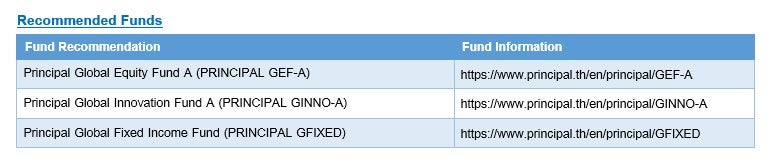 Image
Image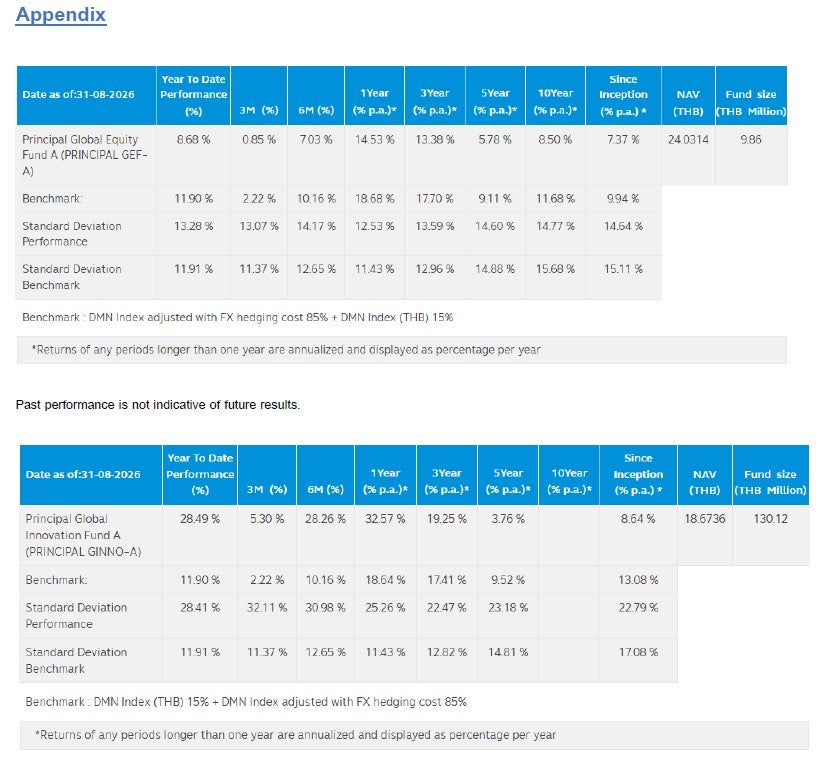
Past performance is not indicative of future results.
Disclaimer: Investors should understand the characteristics of the fund, investment conditions, potential returns, and risks before making an investment decision. PRINCIPAL GEF and PRINCIPAL GINNO invest in underlying funds concentrated in the United States. The Management Company may use derivatives for foreign exchange risk management at its discretion, and certain funds may adopt a dynamic hedging policy ranging from 0%-105% of exposure. Funds investing overseas may be exposed to currency risk, and investors may incur gains or losses from exchange rate movements or receive proceeds lower than their initial investment. Past performance is not indicative of future results/ Investors are advised to review the performance of each unit class of the Fund at https://www.principal.th/th/mutual-fundth before making any investment decision.